

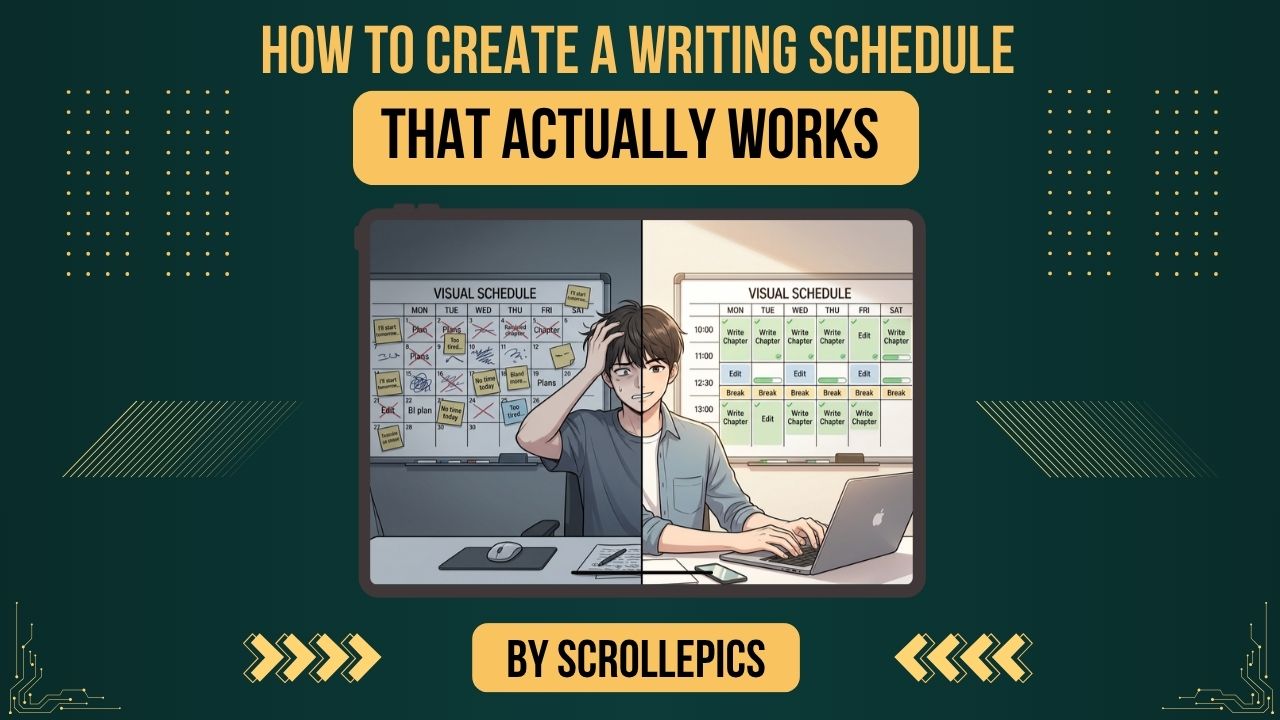
Most writing schedules fail within the first month.
Not because the author is undisciplined. Not because the story is not worth writing. They fail because the schedule was designed around an ideal version of the author’s life rather than the actual one.
You sit down, excited and serious, and you commit to writing five days a week. The first two weeks go well. Then work gets heavy, or you get sick, or a family obligation takes a Saturday, and suddenly you are two days behind. The guilt of being behind makes opening the document feel harder. You fall further behind. The schedule becomes evidence of failure rather than a tool for progress, and eventually you stop consulting it at all.
I have been through this cycle. Every author I know has been through this cycle. And the authors who eventually broke out of it did not do it by finding more discipline or more time. They did it by building a different kind of schedule, one that was designed to survive real life rather than imaginary ideal conditions.
Three serials, five thousand readers, and more chapters than I can easily count. None of it happened on a schedule that assumed perfect weeks. It happened on a schedule that was built, from the ground up, to handle imperfect ones.
This is how to build that schedule.
Why Your Current Schedule Is Probably Wrong Before You Start
The most common scheduling mistake is treating your writing schedule like a production target rather than a system with tolerance for variance.
A production target looks like this: write one chapter every two days, post three times a week, maintain a daily word count of two thousand words. Clear, measurable, motivating.
It is also fragile. One bad week does not just disrupt the schedule. It puts you behind on the target, and being behind on the target creates exactly the kind of psychological friction that makes writing harder rather than easier.
A system with tolerance for variance looks different. It has a buffer built into it. It distinguishes between your writing pace and your posting pace. It assumes in advance that some weeks will be difficult and designs for that assumption rather than hoping it will not happen.
The practical difference is this: when a difficult week arrives, the first kind of schedule breaks. The second kind absorbs the disruption and continues.
Building the second kind requires understanding two things that most scheduling advice never explains: what your actual sustainable writing pace is, and how a buffer between writing and posting transforms the psychological experience of maintaining a schedule.
Step One: Discover Your Real Writing Pace Before You Commit to Anything
Before you design a schedule, you need accurate data about how much you can actually write in a normal week, with a real job, real obligations, and the real cognitive load of daily life.
Not how much you can write in an ideal week. Not how much you wrote last November when you had extra time. How much you can write in a representative week that looks like most of your weeks.
The way to get this data is to run a one-week test before you launch anything publicly.
Write as you intend to write once the schedule is live. Your usual time of day, your usual environment, your usual level of energy at the start of the session. Track your output in raw words per session and per day, and track how long each session actually took.
At the end of the week, calculate two things: your average daily word count across the days you wrote, and your average chapter completion time.
The number that matters for scheduling purposes is not the peak day. It is the average day, and more importantly, the below-average day. Your schedule needs to work on the days when things are slightly harder than usual, because those days will come every week.
Most authors who do this test discover that their sustainable output is somewhat lower than they expected and significantly lower than the heroic numbers that circulate in writing advice. The actual sustainable range for an author with a full-time job who is writing in the margins of their life is closer to one thousand to two thousand words per session, across three to four sessions per week.
If your test produces numbers higher than this, build your schedule around the lower end anyway. The buffer this creates will be used.
Step Two: Build the Buffer Before You Post a Single Chapter
This is the principle that changes everything, and it is the part of scheduling advice that most authors skip because it feels counterintuitive.
Do not post your first chapter until you have twelve to sixteen chapters written and edited.
Post ten or twelve of them as your launch. Keep the remaining three to five as the beginning of a buffer that you will maintain and protect from this point forward.
The reason is structural and psychological simultaneously.
Structurally, a buffer means your posting schedule is never directly dependent on your writing output in any given week. The chapters that readers receive this week were written two or three weeks ago. A difficult week in your life right now does not affect what your readers experience. The posting schedule runs on its own momentum, fed by the buffer, while the writing schedule refills the buffer ahead.
Psychologically, the buffer transforms what the writing session means. Without a buffer, every session is urgent. Missing a session puts you directly behind on a public commitment. The writing carries the full weight of the reader relationship, and that weight is felt in every session.
With a buffer, the writing session is about maintaining a comfortable lead. You are not writing because something is due. You are writing because the buffer needs to be kept healthy, which is a meaningfully different kind of pressure. It is the difference between working to avoid a crisis and working to maintain a position of security.
Set your minimum buffer level at ten chapters and treat that as a line you never allow yourself to fall below. When the buffer drops to twelve, prioritize writing over other discretionary activities until it returns to fifteen. When it reaches twenty, you have the flexibility to take a slower week without any anxiety about the posting schedule.
The buffer is not a luxury. It is the load-bearing structure of everything else.
Step Three: Design the Posting Cadence Around Sustainability, Not Maximum Output
Once the buffer exists, the posting cadence becomes a separate decision from the writing cadence, and you have the freedom to make it thoughtfully.
The question to ask is not how many chapters you can post per week if everything goes well. The question is how many chapters you can post reliably, week after week, for a year or more.
Those are different numbers for most authors, and the gap between them is where most schedules eventually break.
For an author with a full-time job and a healthy buffer, three posts per week is the cadence that most consistently works over a long run. It is frequent enough to keep readers in the habit of returning, specific enough that you can anchor it to particular days, and sustainable enough that a difficult week does not immediately threaten it.
Two posts per week is a legitimate option for authors who write more slowly or whose life is particularly demanding. The chapters at this cadence need to deliver enough per sitting to justify the wait between them, which means they should run toward the upper end of your chapter length range.
Five posts per week is achievable for some authors during high-output periods, but it is rarely sustainable indefinitely. If you want to post at this frequency during a launch phase, build a larger buffer before you start and plan explicitly for the cadence to reduce after the first month.
Whatever cadence you choose, state it clearly in your story’s description. Readers who know when to expect updates build a habit around that knowledge. Readers who have to wonder whether a new chapter will appear today or in a week do not form the same kind of reliable attachment.
Consistency of schedule is more powerful for reader retention than any other single factor. A story that posts twice a week every week will retain more readers over six months than a story that posts erratically at an average of four times per week. The predictability is what builds the habit, and the habit is what keeps readers coming back.
Step Four: Write More Than You Post, Every Single Week
The rule that keeps the buffer healthy is simple.
In any given week, write at least one more chapter than you post.
If you post three chapters this week, write four. If you post two, write three. The one extra chapter per week is the mechanism by which the buffer grows slowly over time rather than staying flat or gradually depleting.
This rule has an important corollary: the extra chapter goes into the buffer, not into the posting queue. The discipline of adding to the buffer rather than posting immediately is what gives the system its resilience. Every chapter you bank rather than post is insurance against a difficult future week.
During the weeks when you write more than one extra chapter, because the writing is going well and the energy is there, add all of the surplus to the buffer. Do not accelerate the posting schedule in response to having a productive week. The productive week is a gift to your future self, not a reason to increase your public commitments.
This asymmetry, adding to the buffer when things go well, drawing on it when things go poorly, is what makes the schedule sustainable across seasons of your life rather than just in the good periods.
Step Five: Build the Tracking System That Makes the Schedule Visible
A schedule that exists only as a mental intention is not a schedule. It is a hope.
A schedule needs to be visible, tracked, and reviewed regularly. The tracking system does not need to be complex. A simple spreadsheet with columns for chapter number, word count, completion date, and posting date is enough. A buffer health indicator that shows how many chapters currently sit between your most recent completed draft and your most recent post tells you at a glance whether the system is healthy.
Check the buffer health once a week, on the same day, as part of a brief planning session. The session should take no longer than ten minutes. You are asking three questions: is the buffer healthy, do I have a clear plan for this week’s writing sessions, and is anything coming up in the next two weeks that will affect my output?
The planning session is where you catch problems while they are still small. A buffer that has drifted down to eleven chapters is a gentle signal to prioritize writing this week. A buffer at nine is a louder signal. A buffer at six is an emergency that requires you to temporarily slow the posting cadence and communicate with readers.
The tracking system is what allows you to respond to these signals before they become crises. Without it, you discover the buffer is critically low at the same moment a chapter is due, which is the worst possible moment to make decisions about the schedule.
Our guide on the best free tools for web novel authors covers the specific apps that make this kind of tracking practical without adding significant overhead to your week.
How to Handle the Weeks When Life Wins
There will be weeks when you write almost nothing. Not because you chose to, but because life did not give you the space.
The buffer exists precisely for these weeks. When a difficult week arrives, do not panic and do not change the posting schedule. Draw on the buffer quietly, let the chapters go out on time, and focus on recovery when the difficult period passes.
What you do not do is apologize to readers in author notes for something they have not noticed. If your buffer is healthy, your readers are receiving chapters on schedule. From their perspective, nothing has changed. The author note that says “I’m so sorry, life got crazy, I barely wrote anything this week” is not for the reader’s benefit. It is for yours, and it is usually counterproductive. It makes readers aware of a fragility in your system that the system itself was designed to conceal.
The only time readers need to know about a difficult period is when it is going to visibly affect the posting schedule. If you need to reduce from three posts per week to two for a month, tell them simply and directly. Give a return date that you are confident you can meet. Then meet it.
When the difficult period ends, rebuild the buffer before you restore the posting cadence. The impulse after a hard stretch is to post more to compensate. The wiser move is to write more and post the same, letting the buffer recover fully before you add any new public commitments.
If you find that difficult periods are recurring frequently enough to regularly threaten the buffer, that is worth examining separately. Our piece on preventing burnout as a web novel author addresses the patterns that lead to sustained output problems and how to address them structurally rather than through willpower.
The Schedule as a Reader Relationship Tool
There is a dimension of the writing schedule that most authors never consciously consider, and it may be the most important one.
Your schedule is a promise to your readers. Not just about when they will receive chapters, but about what kind of author you are. An author who posts consistently, who maintains quality across a sustained period, who communicates clearly when life requires a temporary adjustment, is an author readers trust.
That trust is not just about reader retention, though it is that too. It is about the emotional quality of the reader’s engagement with the story. Readers who trust the author bring a different kind of attention to each chapter. They invest more readily in characters and plot developments because they believe the author will honor the investment.
Many readers are drawn back to a serial not primarily by curiosity about the plot but by the reliable pleasure of a regular delivery from an author they have come to trust. The schedule is the mechanism that creates that reliability. The story is what fills it with meaning.
When the schedule works, it becomes nearly invisible to the reader. They just know that on Tuesday and Thursday there will be something new, and on those days they look forward to it. The habit is so natural they do not think of it as a habit.
That invisibility is the goal. The schedule should be so stable and reliable that readers never have to think about it. They just experience the story, chapter by chapter, without the friction of wondering whether and when the next piece is coming.
That experience is what you are building. The buffer makes it possible. The cadence makes it real. The tracking keeps it honest.
Build the system once and maintain it consistently. The story you are writing deserves readers who never have to wonder if they should trust it.
If you have questions about building your buffer, setting your cadence, or how to recover a schedule that has already slipped, drop them in the comments below. I read every one.

