

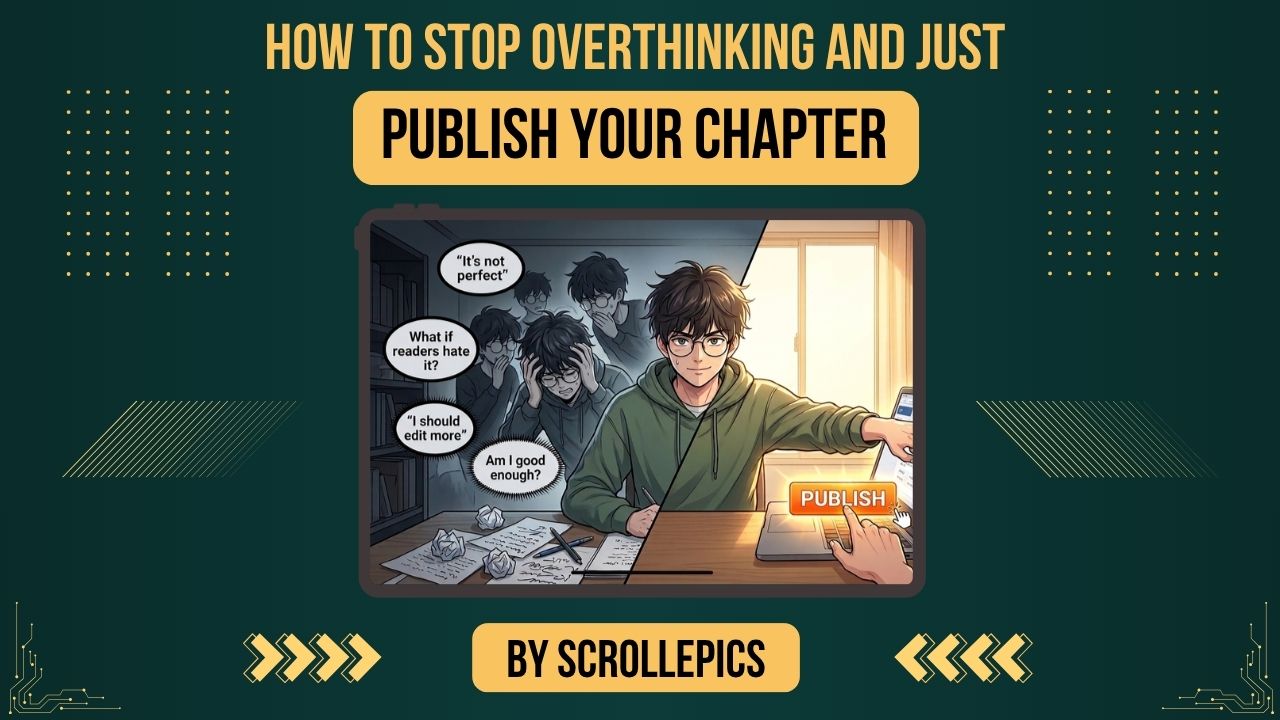
The chapter is done.
You have read it three times. You have fixed the dialogue that felt off, tightened the middle section, and rewritten the ending twice. The document is open in front of you. The publish button is right there.
And you are still not hitting it.
Instead, you are reading the chapter again. Finding new things to fix. Telling yourself that one more pass will bring it to the level it needs to be. Convincing yourself that the readers deserve better than what you have right now, that it would be irresponsible to publish something imperfect, that waiting a little longer is the responsible thing to do.
I know this feeling precisely. I have sat in that exact place more times than I can count, with chapters that were ready, telling myself they were not. The irony is that the authors who obsess most over quality are often the ones most likely to self-sabotage it, because the endless revision cycle produces chapters that are technically cleaner but emotionally flatter than what came out in the first draft.
Three serials. Thousands of readers. What finally broke the cycle for me was understanding what overthinking actually costs, and it costs far more than a typo ever will.
What Overthinking Is Protecting You From
Perfectionism in creative work is not about quality. It is about avoiding judgment.
The chapter in the drawer cannot be criticized. The story that has not been published cannot disappoint anyone. As long as you are still revising, you are still in a state of potential rather than reality, and potential is safe in a way that published work never is.
This is not a character flaw. It is a completely normal response to the specific vulnerability of serial writing, which is more exposed than almost any other creative format. You are not writing a book that sits polished behind a cover before anyone sees it. You are building something in public, chapter by chapter, in front of readers who are watching in real time and who can and will respond to what you produce.
That exposure is real and the discomfort of it is real. Acknowledging this matters because the solution is not to tell yourself to care less about quality. It is to understand that the version of quality you are chasing, the one that would finally feel safe enough to publish, does not exist.
There is no version of the chapter that eliminates all risk of criticism. There is only the chapter you have, the readers who are waiting, and the story that cannot grow until it is in front of the people it was made for.
The question is not whether the chapter is perfect. The question is whether it is ready. And those are completely different standards.
What Readers Actually Care About
Here is the truth about your readers that the perfectionism voice in your head does not want you to hear.
Your readers are not reading your chapters the way you read them.
You read your chapter with full context for every decision you made. You know the line you settled for because you could not find a better one. You know the paragraph that felt forced when you wrote it. You know the transition that does not quite work the way you wanted. You experience the chapter as a record of everything that fell short of your intention.
Your readers experience none of that.
They experience the chapter as a story event. They are asking: did something happen that I care about? Did the character I am invested in move forward? Did the chapter end in a way that makes me want the next one? These are the questions that determine whether they stay, and none of them are answered by the things you are agonizing over.
Readers forgive imperfect prose when the story is moving. What they do not forgive is silence. An author who posts a slightly rough chapter and then posts another one three days later is building a readership. An author who disappears for three weeks while perfecting a chapter is losing one.
The consistency of your presence is more important to your readers than the polish of any individual chapter. Not because quality is irrelevant, but because readers who trust that you will keep showing up invest differently than readers who are always half-wondering whether the story is still going.
That trust is built chapter by chapter, over time, through the simple act of continuing. You cannot build it from a document that never gets published.
The Real Standard for “Ready to Publish”
If perfection is the wrong standard, what is the right one?
A chapter is ready to publish when it does its job.
Every chapter in a serial has a specific job. It advances something, whether that is the plot, the character’s arc, the relationship between two people, or the reader’s understanding of the world. It delivers an emotional beat that earns the chapter’s place in the story. It ends in a way that creates forward momentum into the next one.
If your chapter does those things, it is ready. Not because it could not be better with more work, but because more work is not what the story needs right now. What the story needs is for this chapter to go out so the next one can exist.
The practical test is this: read the chapter once more, not hunting for problems but asking the functional questions. Does something happen that matters? Does the reader have a reason to come back? Does the chapter honor the promise the story has been building?
If the answers are yes, publish it.
If you read it and find that it genuinely does not do these things, then the revision is justified and specific. You know what needs fixing. You fix that thing and publish.
What is not justified is the revision that has no specific target, the one that is driven by a vague sense of not-good-enough rather than an identified problem. That revision is not improving the chapter. It is delaying it.
The Feedback Loop You Are Preventing
Here is something that took me too long to understand, and it changed how I think about early chapters entirely.
The fastest way to improve your writing is to publish it and let readers respond.
Not because readers are writing teachers. Most reader feedback is not technically sophisticated, and some of it is wrong. But the pattern of reader response across multiple chapters tells you things about your writing that no amount of private revision can reveal.
You discover which types of scenes produce the most energy in the comments. You discover where readers get confused, which reveals clarity problems you could not see because you knew what you meant. You discover which characters readers are drawn to in ways you did not expect, which tells you something real about where the story’s emotional center of gravity actually is.
This feedback is only available to you if you publish. Every chapter you hold back is a chapter’s worth of information you are not receiving. The story you are protecting from judgment is the story you are preventing from growing.
The authors who develop fastest are almost always the ones who publish early and iterate in response to real reader engagement, not the ones who polish in private for months before sharing anything. The private polishing produces a technically cleaner draft. The public iteration produces a writer who is genuinely better, because they have been shaped by contact with real readers rather than by their own imagination of what readers want.
Your early chapters do not have to be your best work. They have to be good enough to attract readers who will help you make the later chapters better. That is a meaningfully lower bar than perfection, and it is the bar that actually matters.
Practices That Break the Overthinking Cycle
Understanding why overthinking is counterproductive is useful, but it is not enough on its own. The loop is habitual and it runs automatically, which means interrupting it requires specific practices rather than general resolve.
Set a Maximum Revision Number Before You Start
Before you write any chapter, decide how many revision passes it is allowed to have.
Two is usually enough. One pass immediately after drafting for obvious issues. One pass after a day away with fresh eyes. Then it publishes.
The specific number matters less than the fact that it is decided in advance. When the revision limit is decided before the chapter is written, it functions as a commitment rather than a standard to be met. You cannot justify a third pass by arguing that the chapter still needs work, because you already decided that two passes is what this chapter gets.
This practice will feel wrong the first few times you use it. The chapter will go out with things in it that you wanted to fix and did not. Pay attention to the reader response. Almost certainly, the things you wanted to fix will not register, and the things readers respond to will be things you were not thinking about.
That experience, repeated across several chapters, recalibrates your sense of what ready means in a way that no amount of telling yourself to let go ever will.
Schedule the Publish Date Before You Finish the Chapter
This one is counterintuitive but genuinely effective.
When you begin a chapter, put the publish date in your calendar before the chapter is written. Not a target date, an actual scheduled publication.
The scheduled date changes your relationship to the revision process in a practical way. You are no longer asking when the chapter will be good enough. You are asking what work is achievable before the date you have already committed to. The chapter is going out on Tuesday at eight in the morning whether it is perfect or not, so your job is to make it as good as it can be by Tuesday, not to make it perfect in some unspecified future.
This is how professional serial writers think, and it is a habit you can develop deliberately before it becomes natural.
Treat the Publish Button as a Gift to the Story
The chapter you are holding back is not better for being held. It is getting older, and you are getting more accustomed to its flaws, which means you are finding new ones to replace the ones you fixed.
Publishing the chapter is not exposing a weakness. It is releasing a piece of the story into the world where it can do the thing it was made to do, which is connect with a reader who needed it.
Some readers are going to encounter your chapter in a moment when the story you told in it is exactly what they needed. The timing of that encounter depends on when you publish. Every day you delay is a day that connection does not happen.
That framing is not sentimental. It is a practical understanding of what fiction does and why it matters. The chapter has value that it cannot deliver while it sits in your document.
What to Do About Harsh Responses
At some point, if you publish consistently, you will receive a response that stings.
A critical comment. A low rating. A reader who tells you something about the chapter that you did not want to hear. This is not a possibility to be feared and avoided. It is a certainty to be prepared for.
The preparation is this: decide in advance how you will respond, so you are not making the decision in the moment when you are most reactive.
You will not respond immediately. You will not argue. You will read the response once, close it, and return to it the next day with enough distance to assess it honestly.
From that distance, one of two things will be true. Either the response points to something real in the chapter, a pacing problem, a character moment that did not land, a clarity issue you missed, in which case it is useful information. Or the response is a personal preference, a misalignment between what the reader wanted and what the story is, in which case it is not actionable and you move on.
The authors who accumulate the most loyal readerships are not the ones who receive the fewest critical responses. They are the ones who have been publishing long enough that they have developed the perspective to extract the useful information from critical feedback and ignore the rest, without being destabilized by either.
That perspective only comes from publishing. It cannot be borrowed or imagined. You develop it by doing the thing.
Staying motivated through criticism and the natural fluctuations of reader response over a long serial is its own skill. Our piece on how to stay motivated as a web novel author addresses the specific patterns that cause motivation to erode under reader pressure and how to maintain your engagement with the work through the difficult periods.
When the Overthinking Is Actually About the Story
There is one situation where the overthinking is trying to tell you something real, and it is worth distinguishing from the ordinary perfectionism loop.
Sometimes the reason a chapter will not leave your hands is not that you are afraid of judgment. It is that something in the chapter is genuinely wrong and you can feel it without being able to identify it.
The test is specificity. Ordinary perfectionism produces a vague, general sense of not-good-enough without a clear target. It finds new problems every time you fix the last one. The chapter never reaches a stable state because the dissatisfaction is about your anxiety rather than the chapter’s actual problems.
A genuine story problem produces a specific, persistent discomfort that focuses on the same issue every time you read through. You keep returning to the same scene, the same character moment, the same structural choice, because something there is actually not working.
If you are in the second situation, the revision is justified. Fix the specific thing that is wrong, then publish. Do not let the justified revision become an unjustified spiral by continuing past the identified problem.
The distinction matters because conflating the two is how authors end up revising chapters with genuine problems into versions that are technically cleaner but have lost the element that was actually working. Sometimes the specific problem is not in the prose. It is in the story itself, and that requires a different kind of attention.
If your chapter is stalling because you suspect a deeper structural issue rather than a prose problem, our guide on how to write a compelling main character for web novels covers the elements that make character-driven chapters feel earned rather than obligatory, which is often where the underlying issue lives.
The Story That Only Exists If You Publish It
There is a version of your story that cannot exist yet.
It is the version that has been shaped by reader response. The version where a character you introduced casually has grown into a fan favorite and you have written them more deeply because you knew readers cared. The version where a plot thread you considered cutting has become the emotional center of the story because readers told you what it meant to them. The version of yourself as a writer who has been changed by genuine contact with genuine readers.
That version of the story is better than the one you are polishing right now. Not because it is more technically perfect but because it has been tested against real human response and refined by that testing.
You cannot access it from inside the document. You can only access it by publishing, continuing to publish, and letting the story become what it becomes in contact with the people it was made for.
The chapter you have right now is not your best work. It is the chapter that makes your best work possible.
That is enough.
Publish it.
If you are sitting with a chapter right now that you cannot bring yourself to post, drop a comment below and tell me what is stopping you. Be specific. I read every one, and more often than not the thing that is stopping you is smaller than it feels.

