

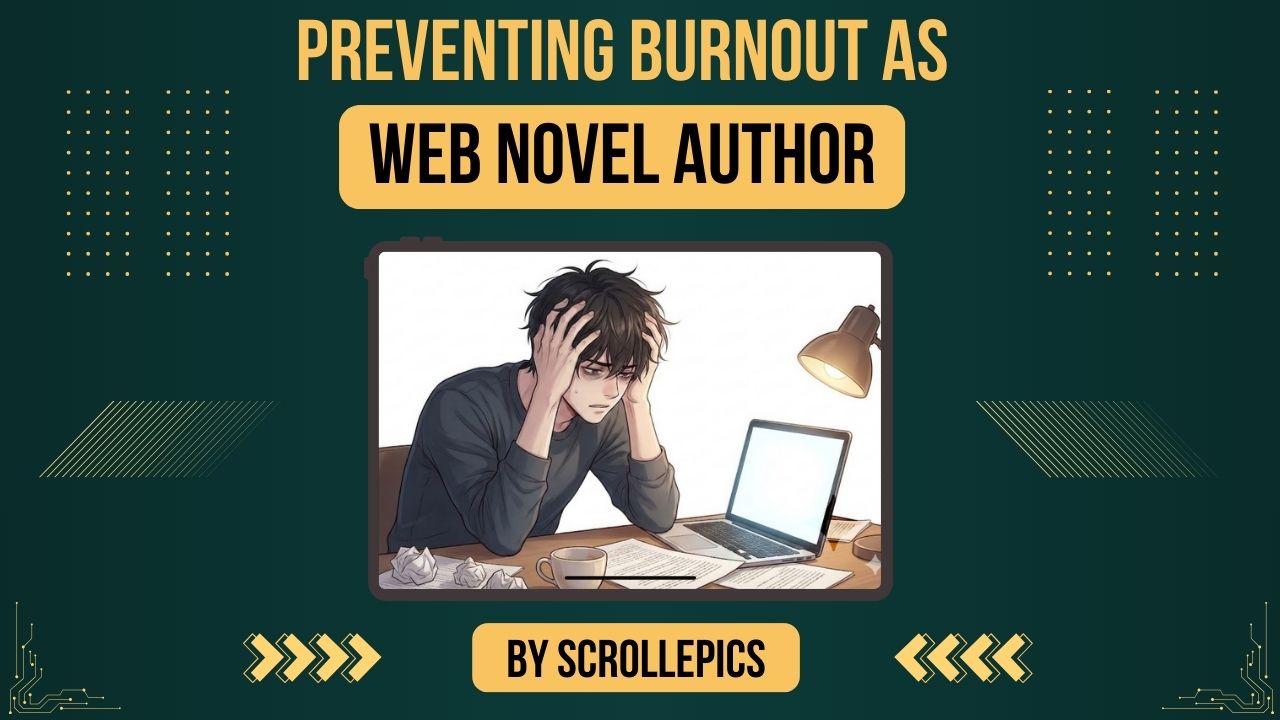
You know that feeling when you open your document, stare at it for twenty minutes, close it, feel guilty, reopen it, and spend another ten minutes rereading old chapters as if rereading counts as writing?
That was me. Every day. For three months straight.
The worst part was that I knew exactly what needed to happen in the story. I had the outline. I had the time. What I did not have was anything left inside me to actually do it.
I had been posting consistently for eighteen months, never missed an update, responded to every comment, hyped every arc. From the outside I looked like someone who had figured it out. On the inside I was hollow, running on habit because the passion had quietly left without saying goodbye.
That is burnout. Not a dramatic breakdown. Just a slow hollowing out until one Tuesday morning the story that used to feel like yours feels like someone else’s obligation.
I am writing this because everything I know about preventing and surviving burnout comes from living on the wrong side of it. Not from productivity blogs or writing theory. From the specific, unglamorous experience of building something I loved, accidentally destroying my ability to love it, and then slowly getting it back.
If you are already exhausted, this will help you understand what is happening and how to climb out. If you are not there yet, it will help you build something that does not quietly collapse the moment life gets hard.
The Hidden Hazards of Web Novel Authorship
Here is what no one tells you when you launch a serial: writing the story is only half the job.
The other half is everything around it. Scheduling, community management, responding to comments, maintaining momentum, performing enthusiasm on days you feel none. None of that switches off when you close your laptop. Part of your brain runs story calculations all the time, even when you are trying to rest.
That invisible work costs real energy. Almost no one accounts for it until they are already running a deficit they do not understand. And because the drain is gradual and invisible, most writers blame themselves rather than the system, which only makes things worse.
But the most dangerous thing is not the workload. It is what the workload starts to do to your sense of self.
It begins subtly. A good chapter means you are talented. A slow week means you are falling apart. Missing a post means you are letting everyone down. Rest stops feeling like rest and starts feeling like a character flaw.
When you reach that point, every option leads somewhere bad. You cannot recover by working harder. You cannot rest without feeling guilty. Understanding how you got there is the first step toward getting out, and the next section shows you exactly what to look for before it reaches that stage.
Recognizing Burnout Before It Derails Your Story
Burnout disguises itself. Most writers explain away the early signs until they are already deep inside it, so here is what to actually watch for.
The first sign is that you stop carrying the story with you. You used to think about your characters in the shower, on walks, mid-conversation. Now the story simply is not there when you step away from your desk. It has become a task rather than something alive inside you.
The second sign is mechanical writing. The words are fine and the chapter is readable, but you know, in the way writers know things, that you are assembling sentences rather than telling a story. You are meeting the word count. You are not actually present.
The third sign is procrastination, and this is the one writers misread most often. It feels like laziness. It is almost always fear or depletion in disguise. When you find yourself doing anything except opening the document, that avoidance is your mind telling you something important: something about writing has started to feel unsafe.
If you recognize yourself in any of this, you are not broken. You built something real enough that losing access to it hurts. What comes next is how you build something that holds up.
Building a Foundation for Enduring Creativity
The advice you have probably already heard is some version of: be more disciplined, write every day, no excuses. That advice has sent more writers into burnout than it has saved, because it treats creative exhaustion as a willpower problem when it is actually a systems problem.
Sustainable writing is about building conditions where creativity wants to show up. That is a different goal entirely.
The most useful thing you can do is develop an honest relationship with your own creative rhythms. Some writers do their best work in long weekend sessions. Others need short daily contact with the story. Some need a detailed outline before they can draft. Others seize up with one and need to discover the story as they go. There is no correct answer, only the one that fits how your brain actually works.
One principle that changes things more than it sounds like it should: stop ending your sessions at a wall. Most writers close the document when they hit a problem they cannot solve, which means every new session opens with that same problem waiting. Instead, stop while you still know what comes next and write it in two sentences before you close the file. You are giving your future self a door instead of a wall.
The other thing worth practicing: separate your drafting brain from your editing brain. The internal critic is useful during revision. During drafting, it is a tax on momentum you cannot afford to keep paying. Write badly on purpose if you have to. The story has to keep moving.
Build these habits before you need them, because when you are already running low, building new habits is the last thing you will have energy for.
Tailored Schedules That Honor Your Limits
The high-output author whose posting schedule you admire is posting that way because it works for their specific life, their specific energy, their specific circumstances. It is not evidence of what you should be doing. It is someone else’s story.
Build your schedule around your actual life: your job, your family, your health. These are not obstacles to your writing career. They are the ground it has to grow in.
The rule I give every writer I work with: commit publicly to less than you can actually deliver. If you think you can post three chapters a week, commit to two. Consistently delivering more than you promised builds reader trust and leaves you breathing room. Consistently falling short erodes that trust and, more damagingly, erodes your confidence in yourself.
Keep two numbers. A private goal that is genuinely ambitious. A public commitment you can meet even on your worst week. The gap between them is your buffer, and that buffer is the difference between a hard week and a crisis.
Once you have a schedule that fits your real life, the next question is what to do when the story itself stops cooperating.
Integrating Breaks Without Losing Momentum
At some point someone told you to take breaks. You nodded, told yourself you would rest after the current arc, and then the arc ended and you started the next one.
I did the same thing.
Breaks are not a reward for working hard enough. They are a structural requirement of creative output. The rest period is where stuck problems loosen, where the thing you could not figure out at your desk becomes obvious while you are making dinner. You are not stepping away from the work. You are doing a different kind of work, one that cannot happen while you are actively producing.
When you need to tell your readers you are taking a short break, do it. The shame of stepping back is almost always worse in anticipation than in reality. Most readers, given the choice between a brief honest pause and weeks of chapters from a writer who has quietly fallen apart, will choose the pause without hesitation.
Psychological Tools for Resilience
Everything up to this point has been about systems and schedules. But the thing that actually keeps writers going long-term is harder to put in a bullet point.
The writers who last tend to treat hard periods as information rather than verdicts. A chapter that is not working is a solvable problem, not proof that you have lost your ability to write. A motivational slump is a signal that something in the current system needs adjusting, not evidence that you were never cut out for this.
The moment “I am stuck” becomes a statement about who you are rather than a description of what is currently happening, you have given the problem far more power than it deserves.
Comparison anxiety deserves its own mention because it quietly fuels more burnout than most writers realize. When you compare yourself to another author, you are comparing your complete interior experience, every doubt and difficult day, to their curated exterior. That comparison will never give you accurate information. It will only make you feel behind in a race you never chose to enter.
The practical tool that helps most: after each writing session, take two minutes to note your energy coming in, your energy going out, and one thing that worked or did not. Do this for a few weeks and patterns emerge that are invisible in the middle of living them. Which scenes drain you. Which ones leave you wanting more. What conditions in your life show up before your best writing and before your worst. That self-knowledge is worth more than any advice, including this.
When You Stop Writing for Yourself
There is a specific kind of burnout that does not feel like burnout at first. It feels like success.
Your readers are engaged. Comments are coming in. People are emotionally invested in your characters. Chapters that lean into what the audience wants get the best response, and chapters that take risks get questioned. Slowly, without a single conscious decision, you start adjusting. You soften things that should have edges. You give readers the moment they clearly want instead of the moment the story actually needs. You start writing toward the comment section rather than toward the story.
By the time you notice, your creative instincts have been quietly overwritten. The story no longer feels like yours. You are still the one typing, but the choices are coming from somewhere outside you, assembled from audience signals and approval patterns rather than from genuine creative conviction.
This is one of the hardest forms of burnout to name because it is wrapped in the appearance of things going well. The numbers are good. Readers are happy. But you feel hollow in a way that is difficult to explain, because the thing you lost was not visible to anyone else.
Reclaiming it requires making a few deliberate decisions that feel uncomfortable at first. Write a chapter for the story rather than for the reaction, even if you are not sure how it will land. Make the story choice your instincts have been nudging you toward, the one you have been avoiding because the comment section might push back. Treat your own creative judgment as the authority it actually is, because you know this story in ways no reader can.
Feedback is worth reading. It is not worth obeying. The difference between a writer who lasts and one who quietly disappears into their own audience is knowing which is which.
Recovering from a Mid-Series Slump
If you are in a slump right now, mid-series with readers waiting and your creative engine stalled somewhere in the middle of the story, the first thing worth knowing is that you are not the only writer this has happened to. Not even close. It happens to most writers who serialize long enough, and it is not the end of the story or the career.
The second thing worth knowing is that the generalized feeling of being stuck is mostly anxiety wearing a story problem as a disguise. The real problem is almost always more specific than it feels.
Sit with the question of what specifically has stopped working. Usually there is a structural issue hiding in the recent chapters, or a story decision made several chapters back that you now know was wrong. Your subconscious has been quietly refusing to cooperate with it ever since, and until you acknowledge it, the engine will not start again. The specific version of the problem is almost always solvable. The generalized version, the feeling that everything is broken and you do not know where to begin, mostly just needs to be broken down into something smaller before it becomes workable.
Going back to your earliest notes helps more than most writers expect. Not the obligation of continuing the story, but the original excitement of the idea before the pressure attached itself. What did you love about this before anyone else was reading it? What made it feel worth telling in the first place? Finding that again is usually where things start to move.
And if you need to take a genuine break and tell your readers, do it. The shame of stepping back is almost always worse in anticipation than in reality, and your readers will understand far more than you are afraid they will.
Epilogue: Thriving in the World of Web Novels
The writers who build lasting careers are not the most talented or the most disciplined. They are the ones who figured out how to stay.
Staying means treating your energy as something finite and worth protecting. It means knowing the difference between what you are sustaining and what you are merely enduring. It means making the same quality of decision about your creative health that you make about your story’s structure, because both of them determine what the story ultimately becomes.
Your story deserves to be told well. That requires a version of you that is rested, present, and still genuinely interested in what happens next.
You are the only person who can tell this particular story. Take care of the person telling it.
If you have questions, or if you are in the middle of burnout right now and want to think through what recovery looks like in your situation, leave a comment below. I read every one. Or, if you want to jump into action, then check out my article on How to Write a Compelling Main Character for Web Novels.

