

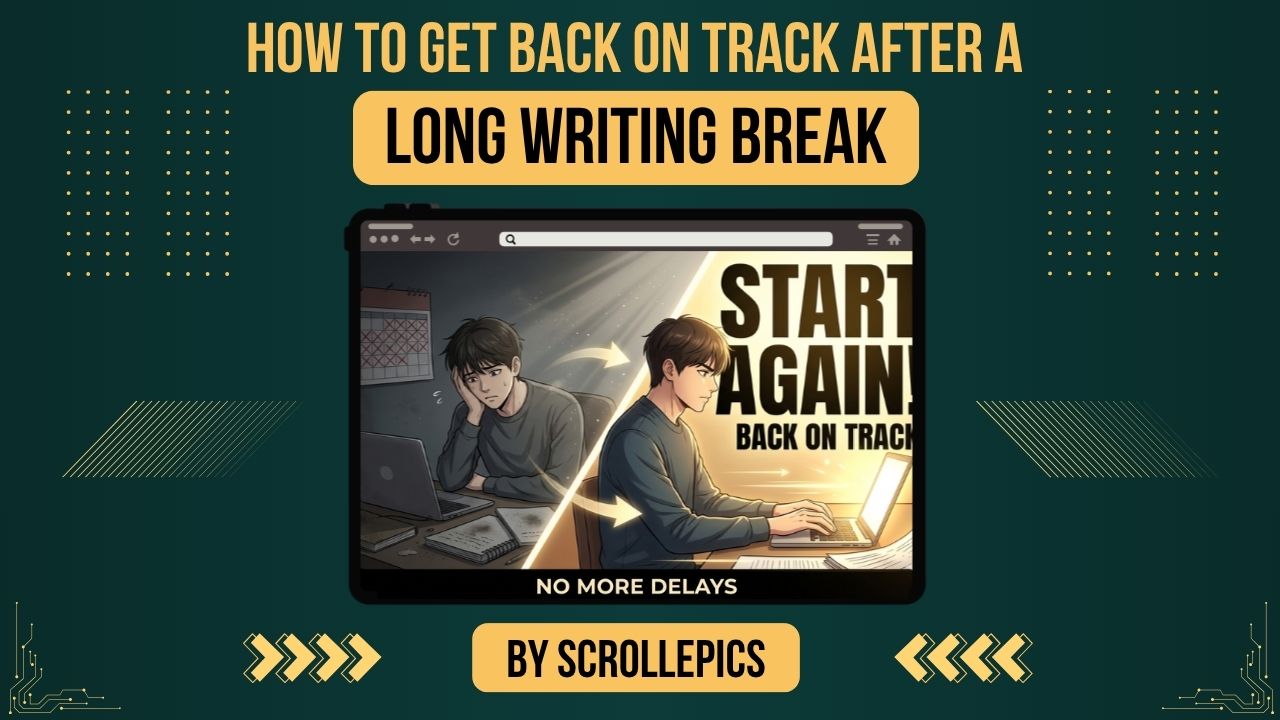
You know the story is still there.
It has been sitting in the back of your mind all this time, not forgotten, just waiting. The characters are still present somewhere beneath the surface. The plot threads you left unresolved have not untangled themselves. The world you built is intact, even if the door to it has been closed for longer than you intended.
The break that was supposed to be two weeks became two months. Two months became six. And somewhere in that time, the gap between you and the story grew heavy with guilt, self-doubt, and a very specific fear that is unique to serial writers: the fear that your readers have already moved on, that the story has cooled beyond recovery, and that reopening the document will only confirm how far you have fallen behind.
I want to tell you something before we go any further.
That fear is not evidence of anything real. It is what a long absence feels like, not what it actually is. I have come back from breaks that felt unsurvivable and found stories that were still alive, readers who were still waiting, and a version of my own voice that had quietly been clarifying during the silence.
This article is the protocol I use every single time. It is not motivational filler. It is a specific, phased approach that respects both the psychological reality of returning after a long absence and the practical demands of a web serial that has readers attached to it.
Start here. Follow the phases. You will be writing again by the end of the week.
Why Coming Back Feels Harder Than Starting
The difficulty of returning after a long break is not about the writing itself. It is about the weight that has accumulated around the writing.
When you started your serial, the document was light. There was no history of absence, no accumulated guilt, no readers wondering where you went. You just opened the file and wrote.
Now the file carries all of that weight. Every time you think about opening it, you are not just thinking about writing the next chapter. You are thinking about how long it has been, about the readers who left comments you never answered, about the readers who stopped checking in, about whether the story still makes sense and whether you can still write the way you used to.
That psychological weight is the actual obstacle, not the blank page.
Understanding this matters because it changes the strategy for returning. If the problem were just about getting words out, the solution would be to sit down and write words. But the problem is about reducing the weight enough that sitting down becomes possible. That requires a different first step.
The first step is not writing the next chapter.
Phase One: Reconnect Before You Produce
Days one and two have a single purpose: fall back in love with the story before you ask anything of yourself.
No word count targets. No pressure to produce anything publishable. Just reacquaintance.
Open the story from the beginning and read it like a reader, not an author. This is harder than it sounds because your instinct will be to edit, to wince at early chapters, to measure the gap between what you wrote and what you now wish you had written. Resist that instinct deliberately. Read to remember why the story mattered to you when you started it.
Most authors who do this report the same experience: somewhere around the fourth or fifth chapter, something shifts. A character does something that surprises you, even though you wrote it. A line lands with more weight than you expected. The world becomes briefly vivid again in a way it has not been during the months of absence.
That moment is not nostalgia. It is recognition. The story reminding you that it was real, that it was worth building, that it is still worth returning to.
While you read, keep a simple document open for notes. Plot threads you left unresolved. Character voice details that might have drifted during the break. The emotional state the story was in when you last posted, because that is the emotional state you will need to re-enter when you write the return chapter.
Do not turn these notes into a project. They are a re-familiarization tool, nothing more.
The Side Scene That Unlocks Your Voice
After the re-read, there is one writing exercise that works better than any other for recovering a dormant creative voice.
Write a scene that has nothing to do with the main plot.
A character moment that would never be published. A conversation between two people in your story that exists entirely outside the canon. Something playful, low-stakes, and driven purely by curiosity rather than narrative obligation.
The reason this works is that it separates the act of writing in your story’s world from the pressure of advancing the story. Your creative voice is still there. It has not gone anywhere. But it has been under-used, and the first attempt to use it for something that matters will feel clumsy and forced. The side scene gives you a way to warm it up in a low-pressure environment before you need to use it for something real.
Five hundred words of anything set in your story’s world will do more for your confidence than staring at the actual next chapter ever will.
Phase Two: Easy Wins Before the Hard Work
Days three and four are about rebuilding writing momentum through achievable tasks, not confronting the most difficult creative challenge waiting for you.
The most difficult creative challenge is the next plot chapter, the one that picks up the story where you left it and has to earn back everything the break may have cost. That chapter is not where you start.
Edit What Already Exists
Pick an early chapter, not the first one, something from the middle of your first arc, and give it a careful editing pass. Tighten the prose. Fix the dialogue that has always bothered you. Catch the continuity details you would handle differently now.
This accomplishes two things simultaneously.
First, it produces real, publishable improvement to your story without requiring you to generate new plot. The work is tangible and satisfying in a way that drafting new material during a creative re-entry period often is not.
Second, it deepens your immersion in the story. Editing requires close attention to voice, to character, to the specific rhythms of how your story moves. By the end of an editing session, you are more inside the world than you were at the beginning.
If you choose to post the edited chapter with a note that it has been revised, many readers will respond positively. It signals that you are back and actively invested in the story’s quality, which is exactly the message you want to send before the formal return announcement.
Write Toward the Story, Not Into It
If the editing sessions go well and you feel ready to draft, write something that approaches the next chapter without being the next chapter.
Write the scene that happens just before where you left off, from a different character’s perspective. Write the internal monologue of your protagonist during the gap between chapters. Write anything that has you actively generating new material in your story’s world without the specific pressure of the return chapter sitting directly in front of you.
This oblique approach to the hard work is not avoidance. It is how experienced writers re-enter a difficult project. You get close enough to the story’s current position that the return chapter becomes a natural continuation rather than a cold start.
Phase Three: Building the Buffer Before You Announce
This is the phase most returning authors skip, and it is the one that matters most for the long-term recovery of the story.
Do not post the return announcement until you have at least three to five chapters ready to publish.
The reason is structural. A single chapter posted after a long break raises a question in every reader’s mind: is this a real return, or is it a false start? One chapter after a six-month silence might just be an anomaly. Three chapters on a consistent schedule is a return.
Readers are protective of their investment in a long-running story. They have waited through the absence, perhaps checked the story periodically for updates, perhaps quietly hoped. When you come back with a single chapter, some of them will wait to see if more is coming before re-engaging fully. When you come back with a buffer and a clear posting schedule, you remove that uncertainty.
Spend days five through seven writing those buffer chapters. Not polishing them to perfection, but getting them to a solid, publishable state. The goal is not to produce your best work before the announcement. The goal is to have enough material ready that the story can resume a regular posting rhythm from day one of the return.
That rhythm is what tells both readers and the story’s ranking algorithm that the serial is active and reliable again.
Writing the Return Announcement Your Readers Will Actually Respond To
When the buffer exists and you are ready to post, the announcement itself requires care.
Readers of long-running serials are not a passive audience. Many of them have invested significant time and emotional energy in your story. The return announcement is the first direct communication you have had with them in months, and how you handle it will set the emotional tone for everything that follows.
The announcement should be honest without being excessive. Briefly acknowledge the absence, without over-explaining or asking for forgiveness. Readers do not need a detailed account of everything that happened. They need to know that you are back, that the story is continuing, and that you are excited about where it is going.
Include the posting schedule clearly. Readers who are deciding whether to re-engage want to know what they are committing to. A clear schedule signals reliability in a way that enthusiasm alone cannot.
Include a genuine expression of what is coming in the next arc. Not spoilers, but emotional direction. What the story is moving toward. What readers can expect to feel. This re-establishes the promise of the story and reminds readers why they followed it in the first place.
Keep the tone warm and personal without being performative. Readers can feel the difference between an author who is genuinely glad to be back and one who is managing optics. Write the announcement the way you would write to a friend explaining your return after a long absence.
What to Do About the Readers Who Left
Some readers will not come back.
This is true after any significant break, and pretending otherwise would be dishonest. The readers who were only loosely attached to the story, who had not yet built a deep enough investment to wait through a long absence, will have moved on to other stories. That is not a judgment on the quality of your work. It is the natural behavior of readers in a format that has an abundant supply of new stories competing for their attention.
The readers who matter, the ones who were genuinely attached, behave differently. They often return when they see the story is active again, sometimes after the story has accumulated enough new chapters to make re-reading from the break point worthwhile. They bring their full investment back with them, and their comments and engagement in the early weeks of your return will be disproportionately meaningful.
Focus on those readers. Write the return arc for them, not for the readers you lost.
The readers you lost were not deeply attached yet. The way to grow your readership back to where it was is to write so well going forward that the story acquires new deeply attached readers while recovering the old ones. The quality of what you produce after the break is more important than any announcement strategy.
The First Chapter Back Is Going to Feel Wrong
I want to prepare you for something specific, because it surprises almost every author who returns from a long break.
The first new chapter you write will not feel like your best work. It will feel stiff, uncertain, slightly off in ways you cannot fully identify. The voice will not be quite where it was. The pacing will feel less natural than you remember.
This is normal. It is the specific friction of re-entry, and it resolves faster than you expect.
Do not judge the return based on the first chapter back. Do not read it immediately after writing it and make conclusions about whether the story can survive. Write it, set it aside for at least a day, return to it with the editing pass, and then assess it honestly.
Most authors find that the chapter is significantly better than it felt during drafting. The voice was there. The uncertainty was internal, not textual.
And even if it is slightly weaker than your best work, publish it. A slightly imperfect return chapter followed by a second chapter three days later is infinitely more valuable to the story’s recovery than waiting until the first chapter feels perfect.
Momentum is the primary asset of a returning serial. Protect it above everything else.
The Structural Problem Underneath the Break
One thing worth examining honestly after a long break is whether the break revealed a structural problem in how you were writing the story.
Many hiatuses are not purely external. Work got busy, yes, or life intervened in genuine ways. But sometimes the break happened partly because the story had reached a point where continuing felt unclear or burdensome, and the external circumstances provided a permission structure to stop.
If that is true even partially, it is worth addressing before you restart.
A story that stalled because an arc lost its direction needs a clearer plan for what comes next before you resume posting. A story that stalled because the protagonist’s arc had become circular needs a genuine development before the next chapter picks up. Returning without addressing the underlying creative problem only delays the next stall.
This is not a reason to delay the return. It is a reason to spend part of the re-entry phase thinking honestly about where the story needs to go, not just what the next chapter contains.
If motivation around the story itself is what you are struggling to recover, our piece on how to stay motivated as a web novel author addresses the specific patterns that cause long-term motivation to erode and how to rebuild it at the source rather than just pushing through.
The Readers Who Waited
Here is something I want you to hold onto during the difficult first days of re-entry.
There are readers who checked your story page periodically during the break. Not constantly, not obsessively, but occasionally. People who genuinely wanted to know if the story was continuing. People for whom the characters you created became temporarily real in the way that only good fiction can make a character real.
They did not leave comments during the break because there was nothing to comment on. They did not know you were coming back. But they were there.
When the return announcement goes up, those readers will find it. Some of them will respond immediately. Some will wait to see if the return is sustained before re-engaging. Some will re-read from the beginning before commenting, because they want to be fully back inside the story before they say anything.
All of them are the reason the story is worth returning to.
Write the comeback arc for those readers. Write it with the full weight of understanding what it means to someone to discover that a story they had given up on is continuing.
That kind of writing, done with that kind of awareness of who is receiving it, is what turns a return into something more than a restart.
It becomes the next chapter in a story that was always going to make it this far.
If you are in the process of returning after a break right now, or if you are at the stage of building your buffer before the announcement, drop a question in the comments. Tell me where you are and what is making it feel hard. I read every one.

