

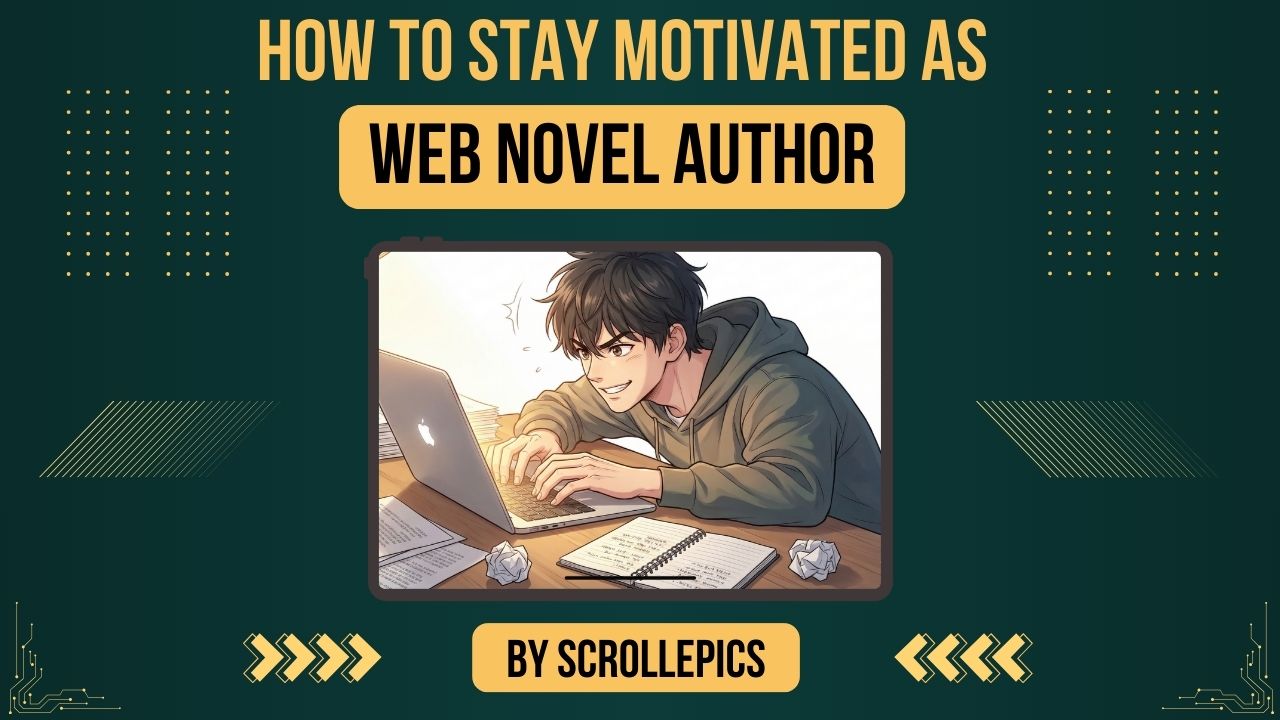
There’s a specific kind of exhaustion that only web novel authors understand.
It’s not writer’s block. That’s almost romantic by comparison.
This is something quieter and more corrosive. It’s sitting down to write chapter 47 of a story you once loved, opening your document, and feeling absolutely nothing. No pull. No urgency. Just the faint memory of a time when you couldn’t not write this story.
I’ve been there. Three series in, and that feeling has visited me more than once.
The first time it happened, I thought it meant I was done. That I’d mistaken temporary passion for real ability. What I eventually learned is that it meant something far less dramatic: I had confused the feeling of motivation with the practice of it.
This article is for the writer who is still early in that lesson.
The Myth of Sustained Passion
Most writing advice treats motivation like it’s a personality trait. Either you have it or you don’t. Either you’re a “real writer” who shows up every day, or you’re someone who just wanted to say they wrote a novel.
That framing is not only wrong. It’s actively harmful.
Passion is not a reservoir. It’s a fire, and fires need feeding. The writers who produce 200, 500, even 1,000+ chapters aren’t superhuman fonts of creative energy. They’ve simply built systems that keep adding wood to the fire even when they don’t feel like it.
The first system is understanding what actually killed the fire to begin with.
Passion fade in web novel writing has a pattern. It rarely announces itself. Instead, it shows up disguised as other problems: the chapter feels slow, the dialogue sounds hollow, the outline that once excited you now reads like a chore list.
You start avoiding your document. You tell yourself you’re “thinking it through,” but really you’re just not writing.
Here’s what’s usually happening underneath: you’ve stopped surprising yourself.
When you started, there was discovery in every scene. But somewhere around the middle, after the setup pays off and before the ending is close enough to smell, the story enters a zone where it’s no longer uncharted. You know where it’s going. The question is only whether you can grind your way there.
That grind is where most serials go quiet.
The fix isn’t willpower. It’s re-introducing the unknown, and there’s a specific way to do it that doesn’t require blowing up your outline.
When I hit this wall in my second series, I added moral weight to scenes I’d originally written as transitional. A conversation that was supposed to be pure exposition became a scene where one character says something that can’t be taken back. A training arc became the place where my protagonist first realizes that winning might cost him the kind of person he wants to be.
These weren’t major plot changes. But they turned known territory into something I hadn’t fully solved yet.
The principle: every scene should contain a question the author genuinely doesn’t know how to answer. Not a plot question. A character question. What does this person do when their values conflict with their goals? What does loyalty look like when it becomes inconvenient?
Those questions bring the discovery back.
Why You Actually Started (It’s Not What You Think)
Ask a new web novel author why they’re writing, and they’ll usually give you one of two answers: because they love stories, or because they have a specific idea they couldn’t let go of.
Both are true. Neither is the whole story.
What most beginning authors don’t recognize is that they started writing because of an emotional need. Something they wanted to process, prove, escape, or inhabit. The idea was just the vehicle.
Maybe you wanted to write the kind of underdog story that would have helped you through a difficult chapter of your life. Maybe you were exhausted by how fiction in your genre handled a certain type of character, and you wanted to correct it. Maybe you just needed a world where hard work actually paid off, where loyalty meant something.
That emotional core is your real “why.”
When motivation starts to fade, it’s almost always because you’ve drifted away from it. Not because the story isn’t good enough or the audience isn’t big enough.
Here’s an exercise that changed how I write: spend fifteen minutes writing not your story, but about your story. Write in first person, as yourself, about what this story means to you. Not the plot. The feeling.
What does it feel like when you get a chapter right? What were you trying to say when you came up with the protagonist? What kind of reader did you imagine finding this story on a bad night?
That document becomes your compass. When the motivation dips, you don’t read your outline. You read that.
Reader Connection Isn’t About Likability. It’s About Truth.
Here’s something that took me an embarrassingly long time to understand.
Readers don’t fall in love with characters because those characters are good people. They fall in love with characters because those characters are honest ones. Honestly drawn, honestly struggling, honestly flawed.
When motivation fades, one of the first things authors tend to do is start writing safer. They smooth out their protagonist’s rough edges. They let the side characters become functional rather than real. They avoid the scenes that are emotionally difficult to write because those scenes require them to sit inside discomfort.
The result is technically competent and completely forgettable.
The chapters that readers remember are almost always the ones that cost the author something to write. The moment of genuine failure. The relationship that ends not with a fight but with silence. The character who makes a choice the author didn’t want them to make, but had to, because it was true.
Readers feel emotional honesty even when they can’t name it. They may not consciously know why a particular chapter hit differently. But they know when something is real, and they know when it isn’t.
If you want to go deeper on building that kind of character foundation before it becomes a motivation problem, this guide on how to write a compelling main character for web novels is worth reading alongside this one.
The Long-Game Problem: Writing Toward 1,000 Chapters Without Losing Yourself
A traditionally published novel might be 100,000 words. Many beloved web serials clock in at two, three, even five million words across their run.
That means the motivational challenge isn’t just getting to the end of the story. It’s staying connected to the story across what amounts to years of your life.
The most practical advice I can give here is structural: don’t outline a thousand chapters. Outline arcs.
An arc is a complete emotional journey. A question asked and answered. Your protagonist wants something specific, faces a particular obstacle, and either succeeds or fails in a way that changes them. An arc might be 30 chapters or 80. But it has a beginning, a middle, and an end.
Within each arc, identify the emotional spine. Not the plot outcome. The feeling you want the reader to finish with. Triumph that feels hollow. Loss that’s also relief. Hope that arrives too late.
When you’re clear on that, you have a target within arm’s reach rather than a thousand chapters away. That difference is what separates sustainable output from eventual collapse.
Between arcs, pause deliberately and ask yourself honestly: does the next arc still excite me?
If the answer is no, that’s not a sign of failure. That’s data. It means the arc needs to be reworked before you write it, not discovered during.
Authors who push through unexciting arcs hoping motivation will return on the other side usually find that readers stop waiting.
When the World Feels Oversaturated (The AI Question)
The volume of content being produced right now is genuinely disorienting. Stories are everywhere. AI-generated fiction is flooding every platform. It’s harder than ever to feel like what you’re making matters.
It’s a real psychological weight, especially for newer authors who haven’t yet built the internal confirmation that their work has value independent of metrics.
But the things that AI genuinely cannot replicate are exactly the things that make web novel readers deeply loyal.
It can’t replicate the experience of reading a character who processes grief exactly the way you did after your own loss. It can’t manufacture the sense that the author knows something about loneliness, about ambition, about the specific texture of a type of friendship, that you thought only you knew. It can’t create the intimacy of a voice that feels like a particular person speaking to you.
Those things come from lived experience and emotional honesty. They come from writers who choose depth over volume, truth over formula.
The answer to saturation is not to write more. It is to write more you.
Building the Habit That Survives the Feeling
Motivation is not the cause of good writing habits. It’s the result of them. You sit down, you write something real, and the act of creation generates the feeling of wanting to create more. Waiting for the feeling to arrive before you sit down inverts the process entirely.
This doesn’t mean torturing yourself into productivity. It means being honest about what a sustainable daily practice looks like for your life. For some authors, that’s 500 words a day without exception. For others, it’s three sessions a week with longer targets. The number matters far less than the consistency.
What helps enormously is removing the decision entirely. Not “will I write today?” but “I write at this time, in this place, until this word count.” The brain stops negotiating when negotiation is off the table.
There’s also real power in stopping slightly before you’re ready. End your session at a point where you know what comes next. Mid-scene, mid-tension, even mid-paragraph. The next session starts already in motion rather than rebuilding from cold.
One thing worth noting: the habits that protect your motivation are closely related to the habits that protect you from burnout, which is its own and more serious problem. If you’ve noticed that motivation loss is accompanied by a deeper exhaustion or a growing detachment from the story, this piece on preventing burnout as a web novel author addresses that specifically. Motivation and burnout aren’t the same thing, and they need different solutions.
The Reader Who Needs This Story
Somewhere, there is a reader who has not found your story yet.
They’re having a version of whatever drove you to write it in the first place. They’re looking for the world-building only you would build, the emotional beats only you would think to hit, the character arc that reflects something they’ve been trying to understand about themselves.
That reader is not waiting for a perfect story. They’re waiting for an honest one.
Motivation, in the end, is not a feeling you generate in isolation. It’s a conversation you decide to keep having. With your characters, with your story’s truth, and with the readers who are quietly, patiently waiting for the next chapter.
Keep writing. Not because it’s easy. Because the story deserves to be finished, and you’re the only one who can finish it.
Have questions about staying motivated or working through a slump? Drop them in the comments below. Whether you’re stuck mid-arc, losing interest in your own plot, or just running on empty, ask away and I’ll do my best to help.

