

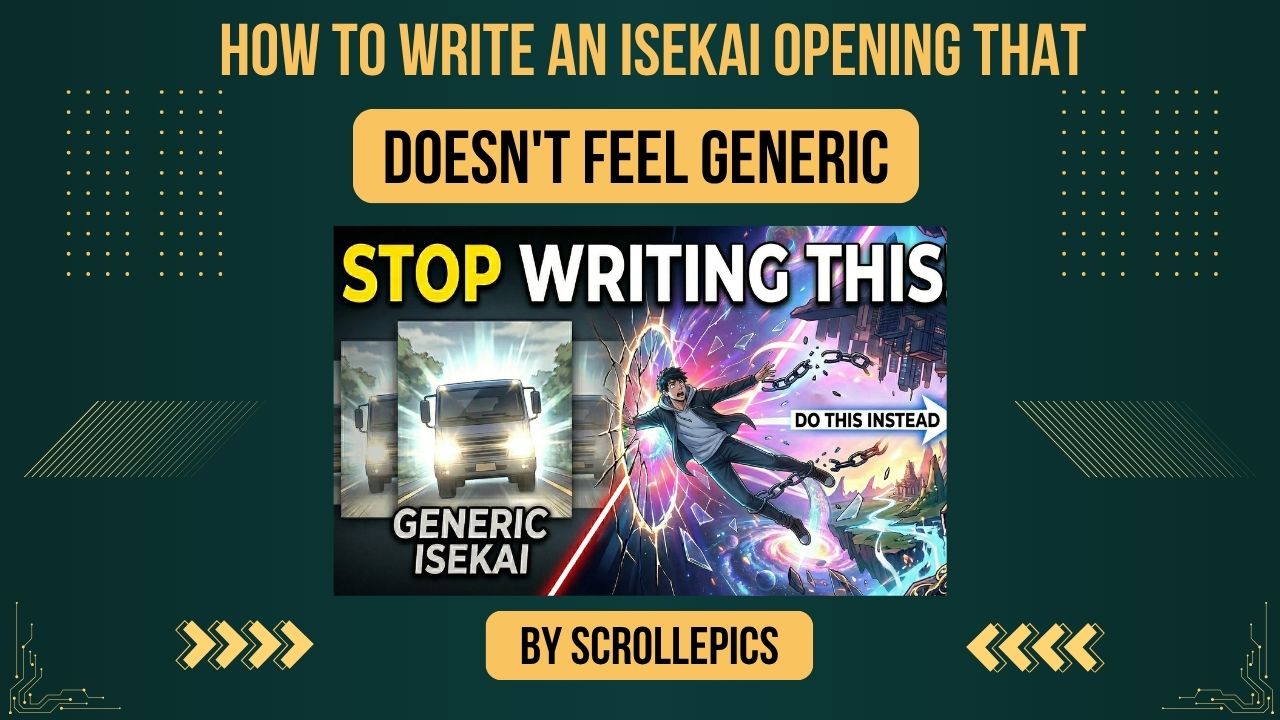
You have the idea. You know it is good. There is something specific about the world you are building, something in the protagonist’s arc that genuinely excites you, something the story wants to say that you have not seen said before.
And then you sit down to write chapter one and something goes wrong.
The opening comes out familiar. The protagonist is in a place readers have been before. The transition into the fantasy world follows a path that feels worn smooth by ten thousand stories that came before yours. You read it back and feel a creeping certainty that a reader who has been through this genre will recognize the shape of what you have written before they have finished the first page.
This is the specific problem of isekai openings, and it is more nuanced than it appears. The problem is not the tropes themselves. The tropes exist because they work. The portal fantasy structure, the protagonist displaced into a world of power and possibility, the collision between a modern perspective and a world that operates by different rules, these things grip readers because they tap into something real about the desire for transformation and a second chance. The genre has an enormous audience precisely because the core appeal is genuine.
The problem is when an author uses the structure without filling it with anything personal. When the opening could have been written by anyone, about anyone, and set in any of the hundred worlds that look exactly like this one.
What makes an isekai opening not feel generic is not subverting the structure. It is inhabiting it so specifically and so personally that the familiar shape becomes entirely your own.
I have built two serials in this genre. I know exactly where the openings fail because I have failed in some of these ways myself. What I am going to give you here is the understanding of what actually differentiates an opening that holds readers from one that loses them before the second chapter.
Why Readers Drop Isekai Stories So Fast
The drop-off rate for isekai chapter one is brutal, and it is worth understanding precisely why.
Readers of this genre are not dropping because they are tired of the genre. They are dropping because they are pattern-matching too quickly and the pattern matches completely.
When a reader opens a new isekai story and can predict, within the first five hundred words, everything that is going to happen in the next three chapters, they have no reason to continue. The story has made itself interchangeable. They have already read this story, effectively, dozens of times.
The specific patterns that trigger this rapid recognition are worth naming.
The extended pre-transition sequence that tells the reader everything about the protagonist’s unremarkable Earth life before anything interesting happens. The death or transport event that is treated as a mechanical gateway rather than a character moment. The protagonist who has no defined personality before receiving power, and then becomes a fully formed character the instant the fantasy world’s systems engage them.
Each of these patterns signals to the experienced reader that the author is following the structure rather than using it. The structure is doing the work and the author is not.
What readers want, even when they cannot articulate it, is to feel the author’s specific intelligence and investment in every decision. They want to sense that this protagonist is a real person with a specific psychology, that this world is a real place with a specific texture, that the transition between them means something particular rather than simply initiating the genre’s standard sequence.
The fix is not technical. It is psychological. You need to know your protagonist more deeply before you start chapter one than the chapter itself will ever show.
If you want to build a protagonist specific enough to survive that pattern-matching test, the work starts long before chapter one. Our guide on how to write a compelling main character for web novels covers exactly what makes a protagonist feel irreplaceable rather than interchangeable.
The Question Your Opening Must Answer
Before you write the first sentence of your isekai opening, there is one question you need to be able to answer clearly.
Why does this specific person need this specific world?
Not why does the plot require them to be transported. Why does this character, with their particular psychology and their particular wounds and their particular unfulfilled needs, require the experience that this world is going to give them?
The isekai that grip readers and hold them across hundreds of chapters are almost always stories where the answer to this question is clear and personal. The protagonist’s arrival in the fantasy world is not random. It is, on some level, exactly what they needed even if they did not know they needed it. The world they arrive in is specifically equipped to force them to confront something they have been avoiding, or to develop something they have been suppressing, or to become something they could never have become in the life they left.
This does not mean the transport has to be literally caused by the protagonist’s inner state. It means that the story you are going to tell requires the protagonist to be the specific person they are, with the specific history they carry, arriving in this specific world. If you could swap out your protagonist for a different character and the story would work just as well, your protagonist is not specific enough yet.
The opening will feel generic if the protagonist is generic. Everything else flows from this.
The Pre-Transition Problem and How to Solve It
The amount of time you spend on Earth before the protagonist enters the fantasy world is one of the most consequential structural decisions in your opening, and most authors spend too long there.
The extended pre-transition sequence exists because authors want readers to understand who the protagonist was before they became who they are going to become. This instinct is correct. The before matters. Without it, the transformation has no baseline to measure against.
But the before needs to be delivered efficiently and through specific, character-revealing details rather than comprehensive life history.
One thousand words of Earth life, used well, can establish a protagonist as fully as five thousand words used carelessly. The difference is in what you choose to show and why.
Show the one thing about the protagonist’s current life that is most in tension with who they are going to need to become. Not their job title, not their family history, but the specific way they are currently failing to be who they could be. The specific belief they hold that the fantasy world will eventually dismantle. The specific void they are trying to fill with the wrong thing.
Show this through one concrete scene, not through explanation. A moment where the protagonist makes a choice that reveals their core wound. A single interaction that crystallizes the problem at the center of their emotional life.
Then move to the transition.
The pre-transition sequence that runs to multiple chapters before the portal opens is almost always a symptom of the author not yet knowing what the essential thing about their protagonist is. When you know it, you can show it in under a thousand words and get to the world.
The Transition Itself: Making It Mean Something
The transition event, the death or summoning or portal or whatever mechanism your story uses, is the most underwritten part of most isekai openings.
Authors treat it as a mechanism. A door the protagonist passes through to get to the interesting part. The door gets a paragraph or two and then the world begins.
This is a missed opportunity of significant magnitude, because the transition is the moment of highest narrative potential in your entire first chapter. It is the moment where the two worlds collide, where the protagonist’s former self meets the threshold of who they are going to become, where the story’s central promise is made in its most concentrated form.
The transition should be visceral and personal.
Not visceral in a gratuitous way. Visceral in the sense that the reader should feel it physically, through the protagonist’s specific sensory experience, rather than understand it intellectually as a plot event.
And personal in the sense that how the protagonist experiences the transition should be shaped by who they are. A character who has been running from things their whole life might experience the moment of transport as a relief before the fear sets in. A character whose entire identity was built around control might experience it as the most terrifying sensation they have ever felt. A character who secretly always wanted to escape might feel, underneath the shock, something that they are ashamed to identify as hope.
These are not decorative details. They are the story beginning. They establish, before the protagonist has said a word in the new world, something true about their psychology that will carry through the entire arc.
Write the transition as if it is the most significant moment in your protagonist’s life up to this point. Because in the context of your story, it is.
Five Specific Techniques for an Opening That Stands Apart
These are not formulas. They are approaches that work because they address the underlying problem of specificity.
Make the Transition a Consequence of Character
The most powerful version of an isekai opening is one where the transport, whatever its mechanism, feels like the direct result of who the protagonist is and what they want or fear.
This does not require a magical explanation. It can be as simple as the protagonist being in a specific place for a specific reason that is rooted in their psychology, and that specific place happening to be where the transition occurs. The reader understands, even if the protagonist does not, that this person was always going to end up here.
When the transition feels like consequence rather than coincidence, the story establishes itself as one where character drives plot rather than the other way around, and readers recognize that distinction and trust it.
Arrive Late
You do not have to begin at the beginning. You can begin the story years after the protagonist arrived in the fantasy world, with the transport sequence delivered as a brief, charged memory at a moment when it becomes relevant.
This approach trades the novelty of the transport scene for the immediate engagement of a protagonist who is already established in the world, already facing something real, already a person the reader can read without the usual orientation period.
It also allows you to establish the protagonist’s pre-isekai self through the specific ways that their Earth background shapes their present situation, which is often more efficient and more interesting than showing that background directly.
Give the Protagonist Something to Lose Immediately
One of the most reliable ways to create immediate stakes is to establish, within the first chapter, something the protagonist values that is now at risk.
Not a life-or-death threat necessarily, though that works. A relationship. A belief. An object of significance. A version of themselves that the new world is already pressuring them to abandon.
Readers connect with characters who have something to lose because loss is a condition of caring. A protagonist who arrives in the fantasy world with nothing at stake and nothing they value is not yet a person the reader can be invested in. A protagonist who arrives already carrying something precious and already in danger of losing it is a person whose situation creates natural urgency.
Let the Protagonist Be Wrong About Something Important
An isekai protagonist who is immediately competent, whose instincts are correct, and whose assessment of the new world is accurate is a protagonist who does not need to grow.
The most compelling isekai protagonists arrive with a false belief about the world or about themselves, and the story is the process of that belief being tested and eventually broken or confirmed at great cost.
The false belief should be specific and rooted in the protagonist’s history. Not a generic underestimation of danger, but a particular way of seeing the world that made sense in their previous life and makes them dangerously wrong in this one.
This wrongness is the engine of your arc. It is what the story is going to dismantle, chapter by chapter. Establish it clearly in the opening and the rest of the story knows what it is for.
Use Voice as Differentiation
Your protagonist’s voice in the opening chapter is the clearest possible signal that this is a different story.
Not a unique voice in the sense of unusual stylistic choices. A voice that is specific to this person, reflecting their education, their emotional state, their relationship to language and thought. A voice that reveals character through its rhythms and preoccupations without explaining anything directly.
A reader who hears a genuinely specific voice in the first paragraph knows immediately that this story is inhabited by a real person rather than an archetype. That recognition is what makes them read the second paragraph.
Read your opening aloud. If the voice could belong to any of the ten most recent isekai protagonists you have encountered, it needs to be more specifically this person.
The First Chapter Test
Before you consider your opening chapter finished, run it through one honest assessment.
Read it from the beginning and ask, after each section: is this specific to this story or could it be from any isekai?
The pre-transition sequence should reveal something about this protagonist that would not be true of a generic counterpart. The transition should feel like it is happening to this person specifically. The opening of the new world should create a question in the reader’s mind that is about this protagonist rather than about the genre’s standard situation.
If any section fails this test, the problem is almost always that you have described what happened rather than shown who experienced it and what it meant for them.
The fix is to bring the protagonist’s specific psychology into every sentence that currently describes events without character. Not through explicit statement but through the selection of details, the order in which things are noticed, the emotional texture of how the experience is registered.
The opening is not the setting up of a situation. It is the introduction of a person, seen in a moment of extraordinary pressure, whose particular way of being in the world is going to be the story’s subject from this page forward.
When that is what your opening delivers, the genre’s familiar structure becomes invisible because the person inside it is too specific and too real to be generic.
Your story is already that specific in your imagination. The craft challenge is making it that specific on the page.
If you are working on an isekai opening right now and you want to share the first three paragraphs in the comments, I will tell you honestly whether the protagonist reads as specific or as a familiar type. I read every comment.

