

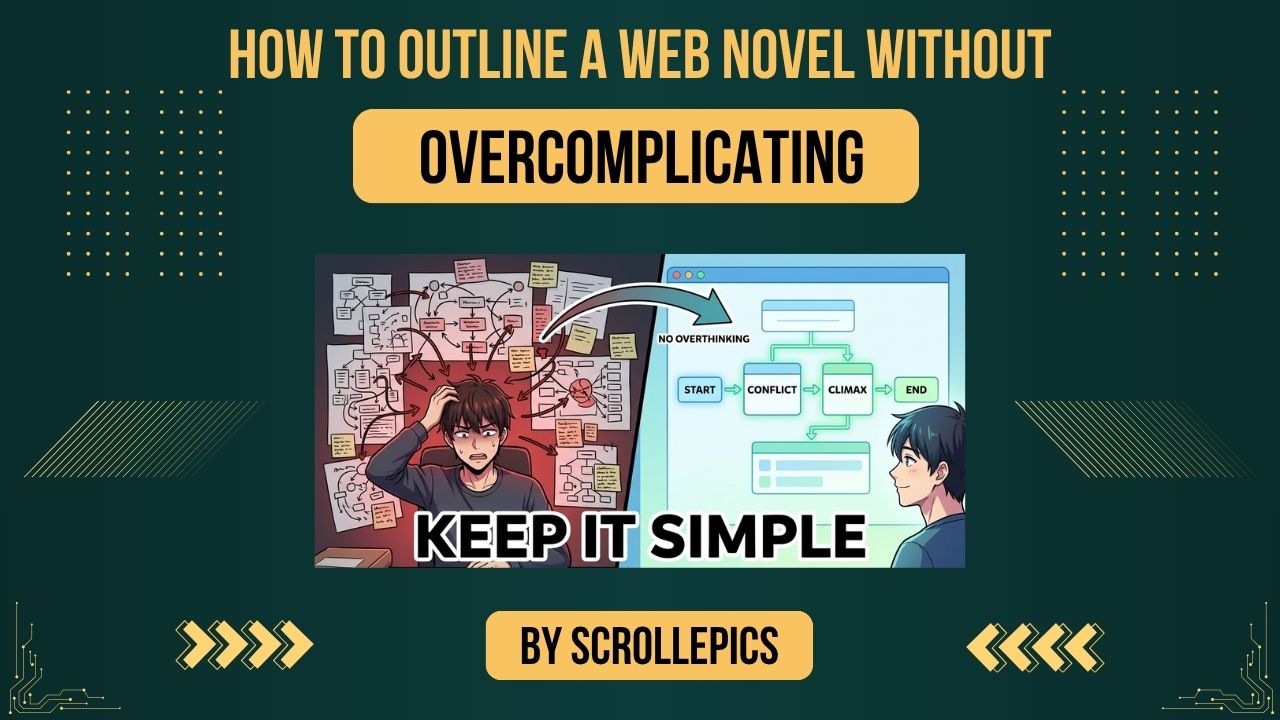
Most writers approach outlining like it is either surgery or surrender.
Either you map every chapter in obsessive detail before writing a single word, convinced that any deviation will cause the entire story to collapse. Or you decide that outlining kills creativity, throw the idea out entirely, and start writing into the dark, hoping the story will find its own shape.
Both approaches fail web novel writers in specific, predictable ways.
The first produces what I think of as brittle stories. They are structurally sound in theory but inflexible in practice. The moment the story surprises you, which it always will, or the moment readers respond to something you did not expect, which they always do, the rigid outline becomes a cage rather than a map. Following it feels wrong. Abandoning it feels terrifying. The story stalls somewhere in the middle of that tension.
The second produces the kind of debt I mentioned in other articles: accumulated plot threads, contradictions, and character inconsistencies that start small and compound chapter by chapter until fixing them feels impossible and continuing feels pointless.
What actually works is something more honest about what web novels are and how they live. They are not finished books waiting to be written. They are ongoing, evolving relationships between a writer and an audience, shaped in real time. The outline that serves them needs to reflect that reality.
I have published three serials and watched hundreds of others succeed or fail. What follows is everything I know about outlining in a way that gives your story structure without stealing its soul.
Why Over-Planning Kills Web Serials Specifically
Before we get into the method, it is worth understanding why this problem is unique to serial fiction.
When you write a standalone novel, you have the luxury of revising the whole before anyone reads any of it. The outline is a private tool. It can be as rigid as you want because the readers will never see the scaffolding, only the finished building.
A web serial is different. You are building the house room by room, and people are moving into the rooms you have already finished while you are still working on the ones ahead. The outline is not a private tool. It is a live blueprint for a structure that is already partially inhabited.
This means over-planning has a specific cost that does not exist in traditional fiction. When you lock every beat in advance and then something unexpected happens, whether that is a character who turns out more interesting than you thought, or a plot development that readers respond to in ways you did not anticipate, you cannot quietly revise the earlier chapters to accommodate the change. Those chapters are already read. They are already part of the reader’s memory of the story.
The over-planner’s dilemma is always the same: honor the outline and write a story that feels increasingly misaligned with what it wants to become, or deviate from it and create continuity problems in chapters you can no longer easily fix.
The solution is not to plan less. It is to plan the right things, and leave the right things open.
The Three-Layer Framework That Actually Works
The outline that serves a web serial has three distinct layers, and each layer requires a different level of detail and a different posture toward change.
Understanding the difference between them is the whole game.
Layer One: Lock the First Arc Completely
Your first arc is the one part of your outline that should be treated like a traditional novel chapter plan: specific, detailed, and followed closely.
Here is why.
The first arc is where readers decide whether they are in. Most readers who will ever follow your serial make their decision somewhere in the first ten to twenty chapters. They are evaluating your premise, your protagonist, your prose rhythm, and most importantly your consistency as a storyteller. They are asking, consciously or not, whether this author knows what they are doing.
A first arc that wanders, shifts tone unexpectedly, or fails to deliver on its own setup reads as an author who does not yet have command of the story. Readers who sense that instability often leave before the story finds its footing, even if the later arcs are genuinely strong.
So plan the first arc in full. Know your inciting incident and what it costs your protagonist to engage with it. Know the central question the arc raises and the partial answer it delivers. Know the emotional state your protagonist is in at the end of the arc relative to where they began, because that change, however small, is what gives the arc its shape.
Plan the hooks at the end of each chapter. These do not have to be explosions. They can be quiet. A question raised. A tension that was present now given a name. A relationship shifted slightly but irreversibly. What they cannot be is nothing. Every chapter needs to leave the reader with a reason to open the next one.
This level of detail in the first arc is your investment in reader trust. It pays dividends for the entire run of the story.
Layer Two: Sketch the Middle Arcs With Intention and Space
Once the first arc is complete and the story is in motion, the outlining approach changes.
For middle arcs, plan the non-negotiable beats and leave the rest open.
The non-negotiables are the things the arc must accomplish for the story to remain on track toward its ending. The major development in your protagonist’s arc. The key revelation that changes the reader’s understanding of the story’s conflict. The moment in the character dynamic that was set up in the first arc and must now be complicated or paid off.
These go into your outline with enough detail that you will not accidentally write past them without noticing.
Everything else, the specific scenes, the secondary character interactions, the texture and pacing of individual chapters, stays flexible.
That flexibility is not laziness. It is where the story breathes. It is where you have room to respond to the things you could not have known before you started writing: which characters have more depth than you initially realized, which thematic threads are resonating with readers, which questions the story itself seems to be asking that you did not consciously plant.
Middle arcs that are entirely pre-planned often feel, to both writer and reader, like the story is just executing a program. Middle arcs that have structural intention but room for discovery feel alive. The difference in the reading experience is real.
Layer Three: Lock the Ending Before You Need It
This one surprises writers who are accustomed to thinking of endings as something you figure out when you get there.
Lock your ending early. Not every scene of it, but the emotional and narrative destination. The resolution your protagonist arrives at. The central question your story has been asking, and the answer it gives. The feeling you want readers to carry after the final chapter.
You do not need to have written the ending to know what it is. You just need to know it exists and what it contains.
This matters for a reason that becomes clear around the midpoint of a long serial, when the gravitational pull of endless continuation starts to assert itself. More arcs. More complications. More side characters with their own plots. The story can keep going indefinitely because serialization creates its own momentum.
Without a locked ending, that momentum has no direction. Stories that do not know where they are going develop a particular kind of drift that readers can feel even if they cannot name it. The chapters keep arriving, things keep happening, but the sense of forward movement toward something meaningful gradually erodes.
Readers who are deeply invested in a story are often more invested in the protagonist’s journey than in any individual plot development. They want to know that the character they care about is moving toward something. A locked ending is your promise to yourself and to them that the journey has a destination.
If you want to understand the structural logic of why endings need to be planned in relation to beginnings, the 7-point story structure is one of the clearest frameworks for seeing how those two endpoints define everything in between.
Building Your Story Bible: What to Include and What to Leave Out
Alongside the arc outline, every web serial needs a Story Bible. This is a separate document, not an outline, but a reference that keeps the story internally consistent across hundreds of chapters.
The Story Bible is where your world rules live. Your magic system or power progression, with its limits and costs clearly stated. Your major factions and their motivations. Your timeline of events that happened before the story began, the history that shapes the present the reader is entering.
It is also where your character cores live. Not every detail of every character, but the essential truth of each major one: who they are at the start, what they want, what they fear, and the direction their arc is moving. The supporting cast gets enough detail to stay consistent, not so much that writing them becomes a checklist.
Most importantly, the Story Bible tracks your planted seeds. Every hint you drop that is meant to pay off later, every question you raise that will eventually be answered, every Chekhov’s gun you introduce goes into this document with a note about when and how it resolves.
This single habit eliminates the majority of continuity errors in long serials. When you reach chapter ninety and you need to know what you said about a character’s backstory in chapter twelve, the Bible has the answer. You are not searching through tens of thousands of words hoping you remember it correctly.
Keep the Bible lean. Fifteen to twenty-five pages is enough for most long serials. More than that and you will stop referencing it, which defeats the purpose.
How to Use Reader Response Without Losing Your Vision
This is the part of web serial writing that traditional craft advice does not prepare you for, and it catches a lot of new authors off guard.
When readers start engaging with your story, their responses contain real information. Not instructions, but information. There is a difference, and knowing it is what separates authors who grow from those who either chase every comment or defensively ignore all of them.
The useful information in reader response tends to be about function, not preference. When multiple readers say a section felt slow, that is information about pacing. When readers consistently misunderstand a character’s motivation, that is information about clarity. When readers react with unexpected intensity to a secondary character, that is information about what is resonating.
This kind of functional feedback is worth taking seriously, not because readers get to write the story but because readers experience the story in a way you cannot. You know the intentions behind every scene. They only have what is on the page. When their experience diverges significantly from your intention, that gap is worth examining.
What is not useful is preference feedback that has nothing to do with function. A reader wanting the story to go in a direction that would require abandoning your locked arc structure. A reader preferring a different kind of protagonist than the one you are writing. These are not problems with the story. They are mismatches between reader taste and authorial vision, and the appropriate response is to continue writing the story you set out to write.
The practice I have found most useful is keeping a simple running document of patterns in reader response. Not individual comments, but recurring themes. If you see the same kind of response appearing multiple times across multiple chapters, that pattern is worth understanding. If it points to a functional problem in the writing, address it. If it is just a vocal subset who want a different kind of story, note it and continue.
The Chapter-Level Hook System That Retains Readers Long Term
An outline is only as good as what it produces at the chapter level, and the thing that makes or breaks individual chapters in a serial is the hook.
Not just the ending hook, though that matters. The opening hook matters equally and receives far less attention.
Your opening hook does one job: it reminds the reader why they are here and pulls them back into the story’s current reality within the first paragraph. Readers are often coming back to your story after days or a week away. They need reorientation, but they need it through the story, not through summary. Drop them into a moment, a feeling, a detail that is specific enough to be evocative and immediate enough to create forward momentum from the first line.
The ending hook is where you create the need to continue. The most effective ending hooks are not always cliffhangers in the traditional sense. The most durable kind is the kind that raises a character question rather than a plot question. What a character will do, who they are becoming, what a choice reveals about them, these hold reader investment across longer gaps than any plot tension because they are about someone the reader cares about rather than an event they are curious about.
Every chapter should deliver something concrete before it ends. A meaningful development in the plot, a revelation that changes the reader’s understanding of something, an emotional moment between characters that shifts a dynamic. Breather chapters are legitimate and necessary, but even they need to deliver something. A quiet chapter that reveals something true about a character is not filler. A chapter where things happen but nothing is felt or changed is.
Readers often connect most deeply with the chapters that slow down rather than the ones that accelerate, provided the slowdown is used to go deeper into character rather than to mark time. Keep that in mind when you are planning the texture of an arc and wondering whether a quieter chapter is earning its place.
The Buffer That Makes All of This Sustainable
Even the most elegant outline collapses without a practical system around it, and the most important practical element for a serializing author is a chapter buffer.
Do not post your chapters as you write them. Build a backlog of at least five to ten chapters before you begin publishing, and treat that backlog as something to be maintained rather than depleted.
The reason is simple. Life is not predictable. Work becomes overwhelming. Health intervenes. Creative momentum stalls during a difficult arc. When any of these things happen, an author without a buffer has one option: go on hiatus. An author with a buffer has a different option: draw it down quietly, recover, and rebuild, while readers continue receiving updates without interruption.
Consistency of posting is one of the primary drivers of reader retention in serial fiction. It builds habitual engagement. Readers who check for your updates on the same days each week develop a rhythm around your story. Disrupting that rhythm costs reader momentum that is genuinely difficult to rebuild.
The buffer is what lets you keep the promise of consistency even during the weeks when keeping it would otherwise be impossible.
What to Do When the Outline Stops Working
Every long serial eventually hits a point where the outline needs to be renegotiated.
You reach a chapter and you realize that what you planned no longer fits who the characters have become. Or you discover a thematic direction the story wants to go that your original outline did not account for. Or you understand, twenty chapters into an arc, that the arc’s original shape was wrong in ways you could not have seen at the planning stage.
This is not a failure. This is the story developing, which means the story is alive.
When it happens, the process is straightforward. Go back to your locked points: the ending, the non-negotiable beats of the current arc. Ask what needs to remain true for those points to still be reachable. Then rebuild the path between where you are and where you need to be, using what you now know about the story that you did not know when you first outlined it.
The Story Bible usually needs updating at this point. The character who has evolved beyond their original arc description needs a new one. The thematic thread that has emerged needs to be tracked.
Do this work in a focused session, outside of your drafting time. Keep it separate from the writing itself.
Then go back to the draft and continue.
The Outline Is the Floor, Not the Ceiling
Here is the thing I most want you to take from this.
The outline is there to protect you from the specific failures that kill serial fiction: broken continuity, purposeless drift, payoffs that were never set up, endings that arrive without earning their emotional weight.
It is not there to prevent the story from surprising you. It is not there to eliminate discovery or instinct or the moments when a character does something you did not plan and it is clearly right.
The best chapters you will write are probably not the ones you outlined in detail. They are the ones where the structure you built created a space, and something unexpected walked into it.
A good outline makes those moments possible rather than accidental. It gives the surprises something to be surprising against.
Build the first arc fully. Sketch the middle arcs with intention and space. Lock the ending before you need it. Keep the Bible lean and current. Buffer your posting schedule before you launch.
Then write the story only you can write, with the confidence of someone who knows where the whole thing is going.
Your readers are waiting for exactly that.
If you have questions about any stage of the outlining process, what to include in your Story Bible, how to structure your first arc, or how to handle an outline that has stopped fitting the story, drop them in the comments below. I read every one.

